
Kearney County Arrest Warrants Explained
Nebraska statutes set the frame. Sections 29-403, 29-404, and 29-406 build criminal process on a written complaint, probable cause, required warrant content, and a direction to bring the accused before the court. The official pretrial guide fills in the practical sequence: a sworn law-enforcement affidavit, judicial review, filing, arrest or service, bond, and first appearance. Kearney County publishes no public arrest-warrant roster, so use Nebraska JUSTICE to find the trial-court case and then ask the issuing clerk about current process. The Sheriff or city police can explain their role in service or custody. Neither agency substitutes for the court's record, which stays with the issuing court itself.
Inside a Kearney County Arrest Warrant
A Kearney County public case can carry a lot of detail. Look for the court, the case number, the complaint, the charged offense, a probable-cause affidavit, the warrant event, bond or release terms, service or return, the next hearing, and any later recall order. Some documents stay sealed or unavailable. The sample schema here describes possible fields only, not a real case.
| Complaint | Written accusation that starts the criminal process. |
|---|---|
| Probable cause | Factual showing reviewed by an authorized judge or magistrate. |
| Warrant direction | Process directing an authorized officer to arrest and bring the accused before court. |
| Release | Bond, personal recognizance, cash, surety, or conditions recorded after the appearance. |
| Return or recall | Later process or court action that may change what the original entry means. |
The Kearney County Arrest-Warrant Timeline
The Kearney County pretrial path is easier to follow when each event stands apart. A law-enforcement affidavit supports probable cause. The complaint and warrant get filed through the court. An authorized officer then receives the direction. Arrest or service brings the person before a judge, bond or another release decision follows, and later hearings, payment, a plea, or a recall add further events.
Written accusation and supporting facts.
Probable-cause decision and process.
Sheriff, marshal, or city/village officer may execute it.
Bond, conditions, counsel, and next setting.
The Nebraska pretrial guide explains this sequence. It does not create a Kearney roster.
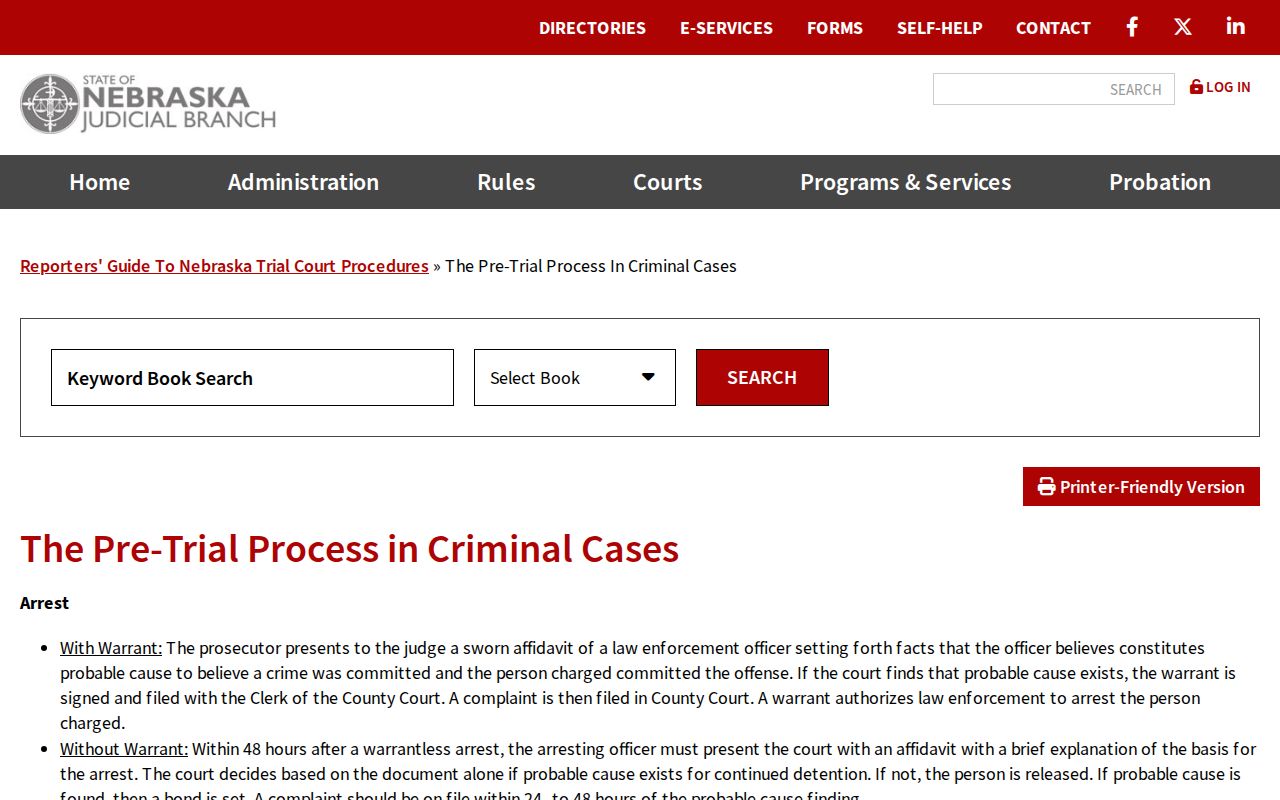
The official image represents process guidance and contains no named Kearney case.
Serving Arrest Warrants in Kearney County
A warrant is directed to an authorized law-enforcement officer, not to a building. The Kearney County Sheriff's duties page covers service of process, arrest and process authority, court attendance, jail custody, investigations, extradition, and possible police-service contracts with cities or villages. Minden Police appears separately for city police functions. That division matters when you ask for a record. The issuing court controls the complaint, warrant, bond, and recall record. The executing agency can explain how it received or handles process. Kearney County posts no public self-surrender window, booking schedule, or warrant counter, so confirm instructions by phone.
Comparing Arrest, Summons, and Bench Warrants
The three labels work differently. A summons or citation calls a person to court without the same immediate arrest direction. A bench warrant is a judge's arrest order, usually after someone misses a court duty. An arrest warrant follows the complaint and probable-cause process. No label reveals current status on its own, and one Kearney County case can hold more than one process event.
| Process | Typical function | Kearney record route |
|---|---|---|
| Summons or citation | Notice to appear or respond | County Court or issuing court record |
| Bench warrant | Judge's response to a court-duty failure | Issuing court controls recall |
| Arrest warrant | Complaint and probable-cause process | County or District Court plus executing agency |
If There's an Arrest Warrant for You
Use JUSTICE first to identify the case and court. Then call the Kearney County clerk before choosing a next step. Ask about the current warrant, first appearance, bond, counsel, payment, or a motion you could file. Recall and release instructions come from the court, not from a third-party message, and an attorney can help interpret the record and plan a lawful response.
Important: Do not use a text-message payment link or rely on an unverified surrender address, and note that Kearney County publishes no booking, bond-window, or after-hours instructions.
Nebraska courts warn that fake arrest-warrant messages demand payment by phone, text, or email. Verify any contact through the official court or Kearney County agency website.
Kearney County Arrest-Warrant Court Levels
Kearney County Court handles traffic, misdemeanors, city and village ordinances, and preliminary felony hearings. A felony can start there and move up. District Court holds the district-level felony, civil, domestic-relations, mental-health, judgment, writ, and order records. Whichever court JUSTICE shows tells you which clerk answers the public record question.
County materials place the Kearney County courthouse at 424 N Colorado, Minden, and you should confirm the counter and hours before visiting.
What the Arrest-Warrant Record May Not Show
A public search has limits. It may omit sealed material, juvenile-confidential records, active investigative files, or a recent event not yet entered. Nebraska Public Records Act section 84-712.05 includes law-enforcement investigatory exemptions, and a document image can be unavailable even when the Kearney County case itself is public. The court-records search policy covers public terminals, Internet searches, fees, and copy limits. Ask for a specific record, not a broad roster.
Search Warrants Are a Different Kearney Record
A search warrant is not an arrest warrant. It authorizes an investigative search of a place, person, or property. An arrest warrant, by contrast, directs an officer to arrest and bring an accused before the court. Search-warrant affidavits and returns can be sealed or governed by separate state and federal procedures, so an arrest-warrant lookup is no substitute for a search-warrant records request. Federal search-warrant filings also sit outside county JUSTICE. District of Nebraska Criminal Rule 41.1 addresses their filing and sealing. For a federal question in Kearney County, use official federal court records.
Confirming the Agency Named in Process
The Kearney County Sheriff answers countywide process questions at 308-832-2805, with office hours of 8:30 a.m. to 5 p.m. on weekdays. Minden Police sits at 246 N Colorado, reachable at 308-832-1150. A village can contract for police service under Nebraska law. Kearney County does not publish which agency currently covers Axtell, Wilcox, Heartwell, or Norman. So do not assume a town has its own force just because it is incorporated. Route countywide matters to the Sheriff. For anything starting in Minden, loop in Minden Police, and for court status call the clerk named on the case.
Kearney Arrest-Warrant Access Rules
Nebraska's Public Records Act, sections 84-712 through 84-712.09, sets the written request framework. Section 84-712.01 covers which records are public, subject to listed exceptions. Juvenile and sealed files stay restricted. Kearney County publishes no copy or certification fee schedule, so ask for an estimate up front and for the statutory reason behind any denial or redaction.
Public record rule: A public case search can locate a complaint or warrant event, but only the issuing court can confirm recall, and only the agency can explain its process.
Use official Kearney County contacts and keep personal data out of public requests. A missing document does not prove no process exists.
Kearney Sheriff Duties and Warrant Process
The official Sheriff duties page lays out the Kearney County Sheriff's role in process service, arrests, court attendance, investigations, jail custody, and extradition.
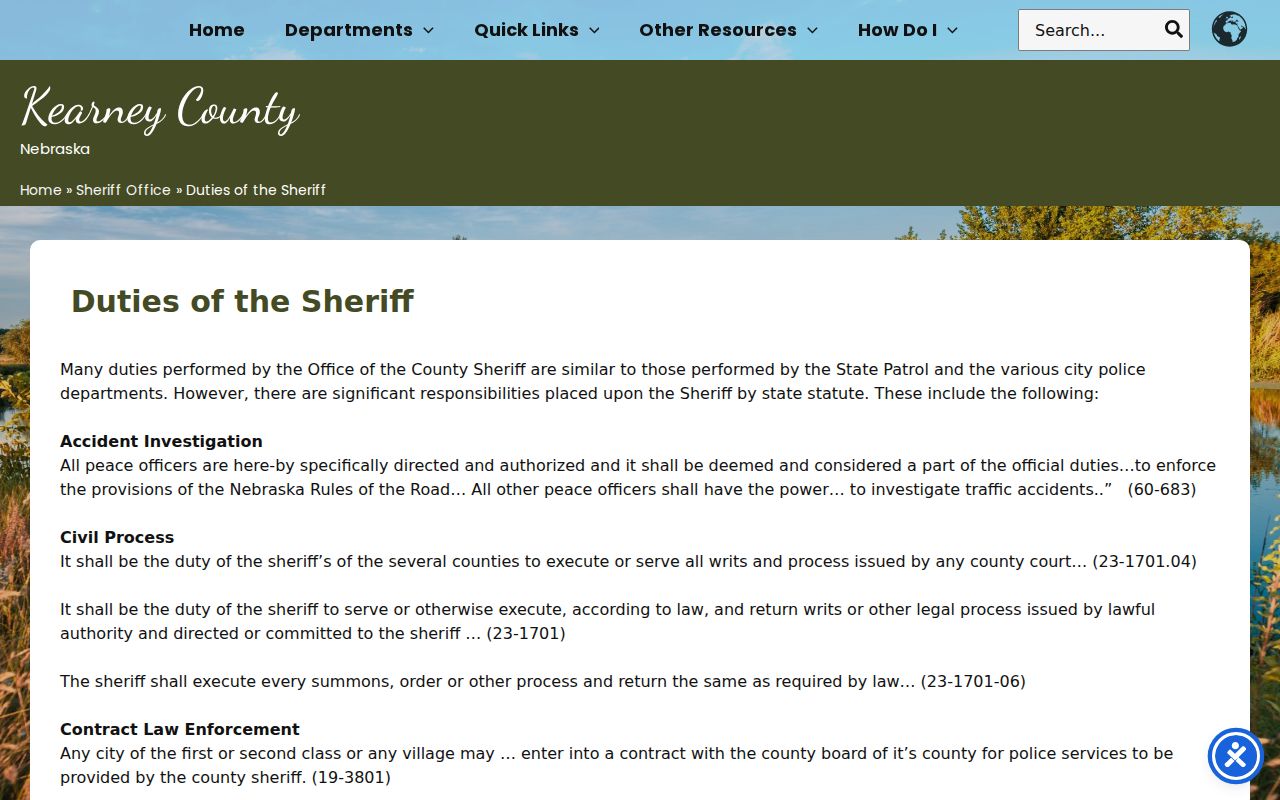
The capture explains agency role; the issuing court still controls warrant recall.